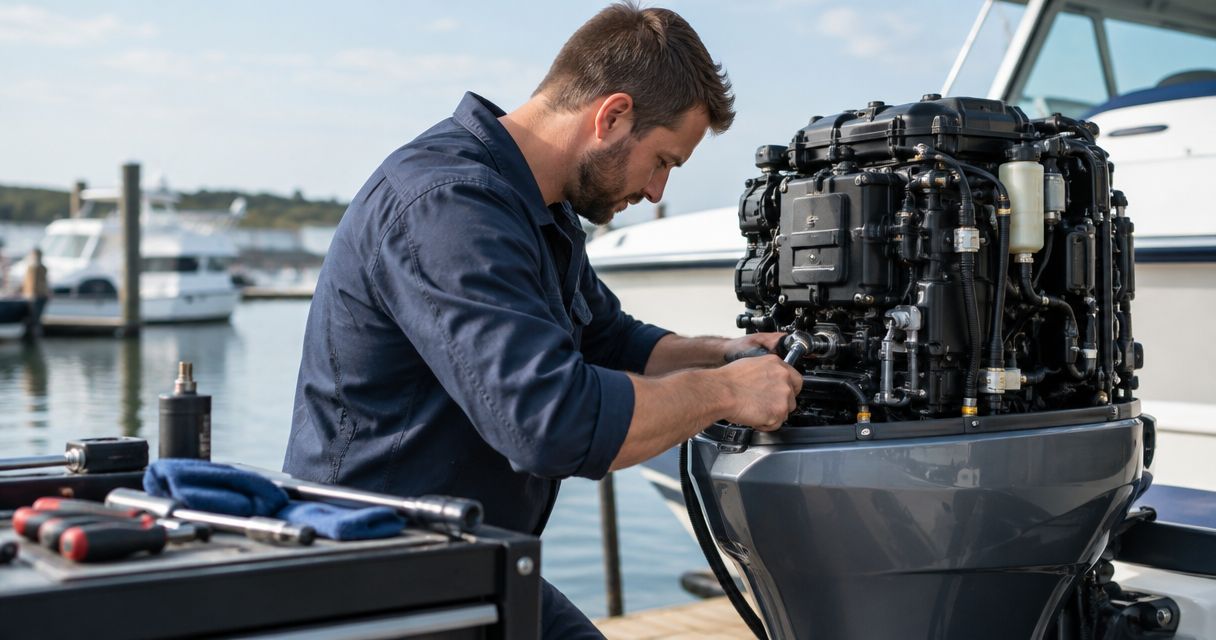
When your outboard needs service depends on how many hours you run it and how long it has been since its last service. Yamaha's general guidance includes maintenance annually or every 100 hours, whichever comes first, but always check your engine's owner's manual for the exact requirements. For South Florida boat owners, flushing after saltwater use and checking for corrosion are part of regular care—not tasks to leave until the next service appointment.
- Outboard motor service intervals depend on your exact model, engine hours, and elapsed time.
- Common intervals: routine maintenance at 100 hours/1 year; expanded service at 300 hours/3 years. Use whichever comes first for each interval; check your manual.
- Flush after saltwater use using the manufacturer's approved method, not a generic engine-running procedure.
- Power Marine provides mobile outboard service in South Florida; report warning signs before booking routine maintenance.
Why this matters in South Florida
A calendar reminder alone does not cover a boat you use frequently. An hour meter alone does not cover a boat that sits unused. Your maintenance plan needs both, plus the care required after saltwater trips.
The practical distinction is scheduled service versus a problem that needs diagnosis. An oil change is maintenance. An overheating warning is a complaint that needs investigation, even if the oil change was completed recently.
If you already have a running problem, the guide to outboard motor repair cost explains how to separate diagnosis, repair work, and routine maintenance when reviewing an estimate.
How often should you service an outboard motor in South Florida?
Use the maintenance table in the owner's manual for your exact engine. Find the engine model and serial number first; the brand name and horsepower alone are not enough to select every maintenance requirement or replacement part.
Yamaha's Maintenance Matters guidance, reviewed in October 2026, identifies annual or 100-hour maintenance and an initial 20-hour milestone for new outboards. It also tells owners to follow their engine-specific manual. Those are useful reference points, not permission to apply a Yamaha checklist to every Suzuki, Mercury, or Honda.
| Maintenance stage | Best for | What sets the timing | Benefit | Limitation |
|---|---|---|---|---|
| Before-use checks | Every planned outing | The owner's manual and visible condition | Helps identify concerns before departure | Does not replace scheduled service |
| After-use saltwater care | Boats used in salt or brackish water | Each outing and the approved flushing procedure | Removes salt and supports corrosion prevention | Does not renew oil, filters, or worn components |
| Initial service | A new engine completing its first service period | The model's break-in schedule | Addresses the manufacturer's early-service requirements | Is not the same as the recurring maintenance schedule |
| Recurring service | An engine operating without a reported fault | Required hours or elapsed time, whichever comes first | Keeps due maintenance organized | Does not establish that an unrelated fault has been repaired |
| Fault diagnosis | Warning alarms, starting trouble, or changed performance | The symptom, not the next service date | Investigates the cause of a malfunction | Is separate from a standard maintenance checklist |
Do not wait for the next interval when the engine reports a problem. Describe the symptom and ask for diagnosis rather than assuming a scheduled service will fix it.
Annual or 100-hour maintenance: check both clocks
Where your manual specifies 100 hours or 12 months, service becomes due when either limit is reached. A boat with fewer than 100 hours is not automatically exempt from annual maintenance. A frequently used boat can reach the hour limit before the year is over.
Record the date and engine hours when the last service was completed. Then record the next due date and next due hour reading for each applicable task. Keep the invoice or maintenance checklist with that entry so you know what was actually done.
For twin or multiple outboards, keep separate records for each engine. A service history for one engine does not establish the condition or completed work on the other. Make sure the maintenance record identifies the relevant serial number.
Full 300-hour service or 3 years: plan for expanded maintenance
Where your engine's schedule specifies 300 hours or 3 years, book the expanded service when either limit is reached. This is a broader maintenance milestone, not a reason to skip the 100-hour or annual services in between. Your exact engine's manual determines the required work.
Mercury's Parts & Maintenance guidance, reviewed in October 2026, describes its 300-hour service kits as including the 100-hour service items plus additional components that vary by engine model. A full 300-hour service therefore needs a model-specific checklist—not one replacement list applied to every outboard.
Before approving the work, ask the mechanic to:
- Identify the engine model, serial number, hours, and previous service history.
- List the routine service items and the additional tasks due at this milestone.
- Confirm the cooling-system, ignition, fuel-system, and other requirements in the manufacturer's schedule.
- Separate required replacements from inspections and condition-based recommendations.
- Record completed work and the next due date and hour reading.
A full service is scheduled maintenance, not an engine rebuild or a guarantee that every component is fault-free. Report alarms, leaks, or running problems separately so they receive diagnosis rather than being folded into a maintenance checklist.
Initial 20-hour service: confirm the new-engine requirements
Yamaha's general guidance includes an initial 20-hour maintenance milestone. The exact break-in instructions, elapsed-time limits, and service tasks still come from the model's manual. Do not substitute a recurring service package for the first-service instructions.
If your outboard is newly installed, ask what documentation came with it and which checks belong to the installation versus the engine's initial maintenance. These are related subjects, but they are not interchangeable.
Buying a used boat is different. An engine that is new to you is not necessarily a new engine, and a low hour reading does not supply a maintenance history. Gather records before deciding which work is due.
What changes your outboard maintenance plan?
South Florida does not create one replacement interval for every engine. It does make your operating conditions relevant to the maintenance conversation. Tell the mechanic how you use and store the boat rather than asking for a schedule based only on your ZIP code.
The useful factors are:
- Saltwater exposure: identify whether you operate in salt, brackish, or fresh water and how you flush afterward.
- Engine hours: report the actual reading and how often you use the boat.
- Elapsed time: provide the last documented service date, not just the season you remember.
- Storage: explain whether the boat has been sitting and whether storage preparation was completed.
- Model-specific requirements: confirm the engine identification before selecting the checklist.
- Reported symptoms: list alarms, leaks, starting problems, or changes in running behavior separately from maintenance requests.
Use your engine's maintenance schedule as the starting point, then review its condition with your mechanic. If earlier service is recommended, ask how saltwater exposure, inspection findings, or the manufacturer's guidance apply to your outboard. This keeps the maintenance plan focused on your engine's needs.
Yamaha's maintenance guidance also distinguishes continuing care from interval maintenance. This is the useful framework for a 2026 service plan: scheduled work handles due tasks, while ongoing inspection and after-use care address exposure between appointments.
What should a routine outboard service include?
A service checklist should identify the applicable manufacturer tasks and distinguish inspection from replacement. Saying that a component was checked is not the same as saying it was renewed. Ask for that distinction on the completed-work record.
For a four-stroke outboard, the scope commonly includes engine oil and filter requirements. Lower-unit lubricant, fuel filtration, lubrication points, cooling-system checks, corrosion protection, and other items depend on the engine's schedule. A two-stroke engine does not use the same engine-oil service procedure as a four-stroke.
Ask the mechanic to organize the work into three groups:
- Due maintenance: the tasks required by the engine's hours or elapsed time.
- Condition-based work: items requiring attention because inspection shows wear, contamination, or damage.
- Fault investigation: checks addressing a specific operating complaint you reported.
This makes the estimate easier to understand. It also gives you a way to approve routine maintenance without accidentally authorizing open-ended repairs.
Power Marine outboard service covers routine maintenance and fault repairs for South Florida boat owners. When discussing the work, explain whether your priority is catching up on scheduled upkeep, investigating a problem, or both. A clear request helps keep the scope focused.
Water-pump attention is not optional
The water pump supplies cooling water to the engine. Yamaha's Additional Tasks guidance recommends annual inspection of the impeller and water-pump assembly as a general rule, while directing owners to the model-specific service interval.
That does not mean every brand requires the same annual replacement. Inspection, scheduled replacement, and repair after a cooling problem are different decisions. Ask which applies to your engine and what the service record confirms.
A recently changed impeller also does not prove that every part of the cooling system is healthy. Report an overheating warning separately rather than assuming the last maintenance visit ruled out all possible cooling faults.
What should you do after a saltwater trip?
Flush the cooling system with fresh water using the procedure specified for your engine. Rinse the exterior as directed, inspect for anything unusual, and maintain the manufacturer's corrosion-prevention routine. Flushing is continuing care, not a substitute for scheduled service.
Yamaha's corrosion-prevention guidance, reviewed in October 2026, describes a 15-minute freshwater flush for its listed procedures. It distinguishes the built-in flushing attachment used with the engine stopped from other methods that have different instructions. Do not treat that duration or engine-running procedure as universal across all outboards.
Before flushing, confirm:
- Which attachment or method your manual permits.
- Whether the engine must remain off or run at idle for that method.
- Whether additional adapters are required for the cooling-water inlets.
- What safety precautions apply, including propeller removal where instructed.
- How to reconnect or secure any flushing fittings afterward.
Never start or crank an outboard without the proper cooling-water supply. If you cannot safely follow the specified method at your boat's current location, ask for guidance rather than improvising.
Corrosion checks should include the areas the manufacturer identifies, not just the cowling's appearance. Yamaha notes that exposed metal, electrical connections, and internal cooling passages all need attention. It also warns against painting or covering sacrificial anodes, which need the correct exposure to work.
When should you contact a mechanic before service is due?
Contact a mechanic when starting behavior, running quality, shifting, or warning indications change. The observation tells you something needs attention; it does not identify the failed part. Describe the event without naming a replacement component as the diagnosis.
Useful details include:
- Whether the engine was cold or warm when the problem occurred.
- Whether it happened at idle, while accelerating, or under load.
- The exact warning message, alarm, or gauge indication.
- Whether the problem affects one engine or several.
- Any recent maintenance, fueling, grounding, or propeller impact.
An overheating or oil-pressure warning is not a reason to keep running until the next service appointment. Follow the manual's warning response and prioritize safe assistance if you are on the water. Do not repeatedly restart the engine to see whether the alarm disappears.
A change in the visible cooling-water stream also deserves attention, but that stream alone is not a complete cooling-system test. Normal behavior varies by model. Report the change alongside any temperature reading or alarm instead of treating it as proof that the impeller failed.
How should you prepare for mobile outboard service?
Power Marine is a mobile marine service serving South Florida. For a mobile outboard service request, explain where the boat is located and how the engine can be accessed. Confirm the work arrangements before the appointment; not every task has the same access or testing needs.
Send the following information with your request:
- Engine brand, model, serial number, and current hours.
- Last service date and the corresponding hour reading.
- Previous invoices or a maintenance checklist, if available.
- Whether the boat is afloat, on a lift, or on a trailer.
- Your symptom description and photographs of relevant warning displays.
For a 2026 service record, ask that completed tasks, inspection findings, and next due milestones are documented separately. If the engine has a fault, ask how the proposed repair will be checked and what requires your approval before additional work begins.
Power Marine outboard service is a fit for South Florida owners who need mobile routine maintenance or diagnosis of an operating problem. To discuss your engine's requirements, contact Power Marine with its identification, hours, and service history.
FAQ
How often should I service my outboard motor in South Florida?
Follow the service intervals in your exact engine's owner's manual by both hours and elapsed time, whichever comes first. Yamaha's general guidance includes annual or 100-hour maintenance, but other engines and individual tasks can have different requirements.
Does an outboard need annual service if I barely use the boat?
Follow the calendar interval even when the engine has not reached its hour limit. Low hours do not cancel elapsed-time maintenance or the need to review storage conditions.
Should I flush my outboard after every saltwater trip?
Flush after saltwater use using the manufacturer's approved procedure. Confirm the attachment, duration, engine-running instructions, and safety precautions for your exact model.
Is a 100-hour service just an oil change?
A 100-hour service should address the manufacturer's applicable maintenance tasks, not just an oil change. Ask which items are inspected, which are replaced, and which belong to a different interval.
Do all outboards need a new water pump every year?
Water-pump inspection and replacement intervals depend on the model. Yamaha's general guidance recommends annual impeller and pump-assembly inspection, while directing owners to their engine-specific service requirements.
Can routine service fix an overheating alarm?
Routine service does not establish the cause of an overheating alarm. Report the warning as a separate complaint, follow the manual's warning response, and request diagnosis before treating a maintenance item as the repair.
Does Power Marine provide mobile outboard service?
Power Marine provides mobile marine service throughout South Florida, including outboard repairs and routine service. Share your boat's location, engine details, and access arrangements when discussing an appointment.
One last thing
Keep the next due date and next due hour reading together. Neither tells the whole story on its own, and a service reminder without a completed-work record leaves you guessing which tasks were done.
Before your next 2026 appointment, collect the engine identification and last invoice. If the records are missing, say so. Building a documented maintenance baseline is more useful than guessing that a previous owner must have handled it.
Manufacturer guidance
Technical reference: Yamaha Outboards' Maintenance Matters, Engine Oil & Lube, Corrosion Prevention, and Additional Tasks guidance, reviewed October 4, 2026. The Yamaha examples describe general Yamaha guidance, not a service specification for every make or model. Your exact engine's owner's manual governs the required procedure and schedule.